USB vs Bluetooth vs WiFi vs 4G Data Logger: Which Is Best
The appropriate temperature data logger depends on how data must be accessed, whether real-time alerts are required, and whether the monitoring location is fixed or mobile. USB is well suited to post-shipment data retrieval, Bluetooth provides short-range wireless access, while WiFi and 4G enable network-connected monitoring for fixed or remote applications. Freshliance covers these use cases with USB, Bluetooth, WiFi, and 4G devices for cold chain, storage, laboratory, and transport workflows.
USB vs Bluetooth vs WiFi vs 4G Temperature Data Logger Comparison
Feature | USB | Bluetooth | WiFi | 4G |
Data retrieval | Computer via USB | App / Cloud (via Gateway) | Cloud / App | Cloud / App |
Network dependency | None for data retrieval | Bluetooth range; Internet required for cloud sync | WiFi + Internet | Cellular network |
Remote monitoring | No | Via smartphone/cloud or gateway, model-dependent | Yes | Yes |
Typical use | Shipment monitoring | Local or nearby inspection | Fixed-site monitoring | Mobile and remote assets |
Real-time alerts | Usually no | Model-dependent | Yes | Yes |
Main limitation | Physical access required | Short communication range | WiFi coverage | Cellular coverage |
Best suited for | Post-delivery records | Nearby wireless data access | Continuous fixed-site monitoring | Mobile and remote monitoring |
Understanding Temperature Data Logger Connectivity Options
USB for Simple Trip Records
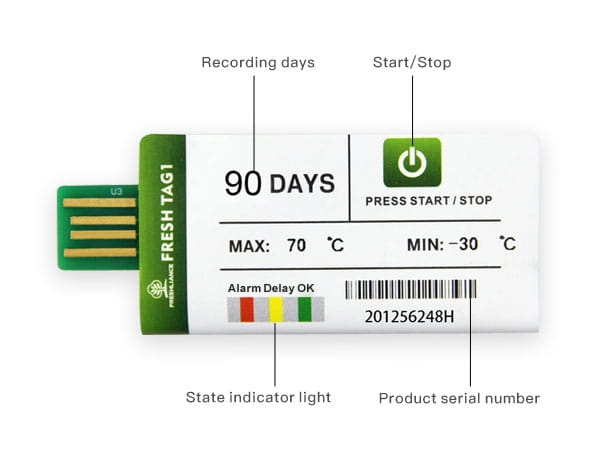
A USB temperature data logger is a practical option when temperature records only need to be retrieved after delivery. The logger is placed with the shipment and records temperature throughout transportation until the data is retrieved at the destination.
Freshliance's Fresh Tag 1 USB temperature data logger is designed for single-use temperature monitoring during transportation and storage. It records temperatures from -30°C to +70°C with ±0.5°C full-scale accuracy and supports up to 300 days of recording and 129,600 readings. Data can be automatically exported through USB in PDF and/or CSV format without additional software.
Bluetooth for Local Wireless Review
Bluetooth is useful when staff need short-range wireless data retrieval without physically connecting the logger to a computer. Depending on the logger design, packaging, and surrounding environment, users may be able to review data without opening the shipment or storage unit. It is especially useful for last-mile delivery, cold rooms, small warehouses, laboratories, and receiving points where a phone-based workflow is faster than a cable-based process.
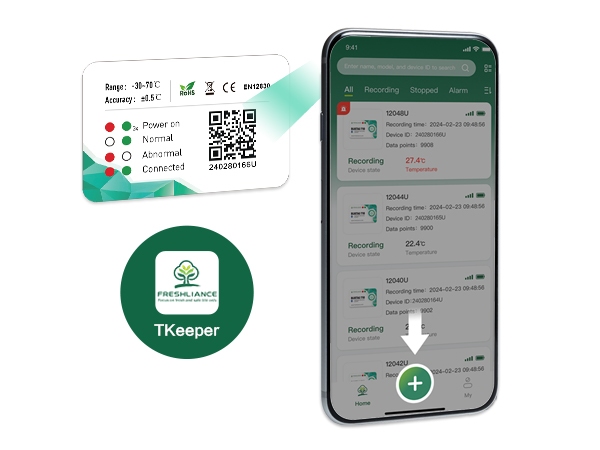
Freshliance BlueTag devices use Bluetooth 5.2 and support app-based review through Android and iOS. The BlueTag T10 Bluetooth temperature data logger is a compact Bluetooth temperature data logger designed for wireless data access in logistics, warehousing, and storage applications, with PDF/CSV reports, a 1 to 99 minute recording interval, 0 to 72 hour start delay, up to 6 alarm points, up to 65,000 temperature readings, and a -30 C to +70 C temperature range.
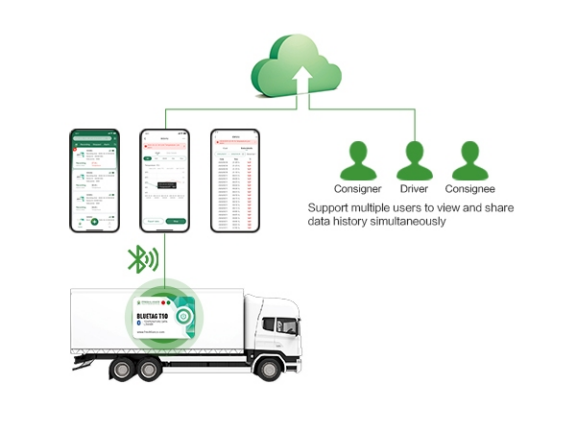
Bluetooth itself is a short-range communication technology rather than a cellular or internet connection. Enabling remote cloud access typically requires a computer or smart device, as well as a gateway (depending on the specific system architecture of the recorder).
When WiFi and 4G Monitoring Make More Sense
WiFi for Fixed Cold Rooms and Refrigerators
WiFi temperature monitoring is well suited to continuous monitoring in fixed facilities where reliable network coverage is available. Cold rooms, pharmaceutical refrigerators, freezers, laboratories, and warehouse zones benefit from automatic cloud upload because teams do not have to visit each logger to collect records.
A WiFi temperature data logger is also useful when several people need the same data. Quality staff, warehouse supervisors, and managers can review trends or alarms through the cloud.
4G for Transport and Off-Site Visibility
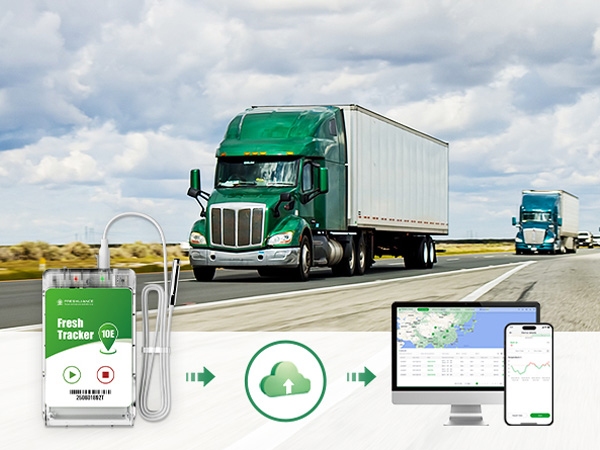
A 4G temperature data logger is the stronger choice when goods are transported beyond the reach of local networks or require continuous monitoring during transit. Refrigerated trucks, containers, pharmaceutical shipments, and other cold chain applications can benefit from cellular connectivity to maintain real-time visibility throughout the transportation process.
Freshliance Fresh Tracker 10E 4G Data Logger for Temperature and Geolocation Monitoring is designed for real-time monitoring during transportation. It uses 4G connectivity to upload temperature and location data to the cloud platform, allowing users to access shipment status remotely through the mobile app or web platform. The device supports real-time temperature alerts via SMS, email, and app notifications, while stored data can be automatically uploaded after network recovery to prevent data loss. Optional external probes are available for applications requiring temperature measurement at separate sensing points.
Choosing the Right Temperature Data Logger for Cold Chain Applications
Food and Pharmaceutical Shipments
For food, seafood, fruit, meat, dairy products, and pharmaceuticals, the first question is whether temperature excursions need to be identified during transit or only documented after delivery. If the primary requirement is post-delivery temperature documentation, a USB logger is often enough because it is small, simple, and easy to file with shipment records.
If the receiving team needs to review temperature history before opening a shipment, a Bluetooth logger may be more practical when wireless access is possible through the packaging. Freshliance BlueTag models allow nearby review and data sharing through the app, which helps logistics and receiving teams review temperature history more efficiently during handover and acceptance procedures.
Warehouses, Laboratories, and Freezers
Fixed storage applications typically require continuous monitoring, trend analysis, and timely alarm response rather than one-time post-delivery data retrieval. A laboratory refrigerator, freezer, or warehouse cold room may require repeated checks, ongoing trend review, and timely response when temperature conditions exceed predefined alarm thresholds.
WiFi Temperature data logger is a practical option for fixed monitoring locations where reliable wireless network coverage and power are available, such as cold rooms, refrigerators, freezers, laboratories, and warehouse areas.
Product Details That Affect Daily Use
Reports, Memory, and Alarm Settings
Connectivity is only one of several factors that should be evaluated when selecting a temperature data logger. A practical temperature data logger also needs the right report format, memory capacity, alarm logic, and recording interval for the application.
USB devices such as Fresh Tag 1 USB temperature data loggers are strong for PDF and CSV trip reports. BlueTag T10 Bluetooth temperature data logger adds Bluetooth access with configurable intervals, delayed start, and multiple alarm points, while Coeus-WiFi/4G supports automatic cloud upload, SMS, email, and mobile app alerts for faster response.
Battery, Probes, and Cloud Access
Battery design matters when a logger is used for a single shipment, repeated internal checks, or continuous storage monitoring. Single-use loggers are convenient for one-way shipment monitoring, while reusable Bluetooth, WiFi, and 4G devices are better suited to recurring monitoring workflows when supported by the specific model.
Probe configuration varies by model. Built-in sensors are suitable for general ambient monitoring, while models with external probes can measure temperature at a separate or hard-to-reach sensing point, such as inside a freezer, refrigerator, cabinet, or insulated container.
How to Select a Temperature Data Logger for Your Application
The right temperature data logger depends on how and when the data needs to be accessed, as well as whether local, cloud-based, or real-time monitoring is required. If review happens after delivery, choose USB. If review happens nearby during handover, choose Bluetooth. If review happens from another office or across several users, choose WiFi or 4G.
This approach keeps the decision grounded in workflow rather than technology labels. Freshliance products can support basic documentation, app-based local review, and cloud-based monitoring, but the best option is the one that matches the user's required response time, data accessibility, and monitoring architecture.
Conclusion
A temperature data logger should fit the way data is collected, reviewed, and acted on. USB and Bluetooth are generally suited to data retrieval workflows, while WiFi and 4G are better suited to network-connected monitoring and remote alerts, depending on device architecture.
Freshliance gives cold chain teams a practical path from basic USB reporting to app-based Bluetooth review and real-time WiFi or 4G monitoring. Explore Freshliance temperature monitoring solutions to match the right logger to your shipment, storage room, laboratory, or transport route.
FAQ
Q: Is a USB or Real-time temperature data logger better for cold chain monitoring?
A: USB is better when the record only needs to be reviewed after a shipment arrives. Real-time monitoring solutions are better when teams need continuous visibility, remote alerts, or cloud access during storage or transport. The best choice depends on when the data must be accessed, whether real-time alerts are required, and who is responsible for responding to temperature excursions.
Q: When should I choose a Bluetooth temperature data logger?
A: Choose Bluetooth when staff need nearby access without physically connecting the logger to a computer, and in some applications without opening the shipment or storage unit when wireless access is possible. It is useful for last-mile delivery, receiving checks, small warehouses, and laboratories where mobile app review is faster than USB download but full-time cloud monitoring is not always necessary.
Q: Which Freshliance logger type fits long-term storage?
A: Long-term storage usually benefits from reusable Bluetooth, WiFi, or 4G loggers because records must be reviewed repeatedly. For cold rooms, laboratories, and pharmaceutical refrigerators, Freshliance WiFi/4G models add cloud access, alerts, and automatic upload, while Bluetooth models work well for nearby routine checks.
Previous: LoRa Temperature Monitoring for Smarter Cold Storage
Next: No