Blood Cold Chain Monitoring: Choose the Right Data Logger
Temperature monitoring is a critical part of blood cold chain management, particularly during storage, transportation, and handover of temperature-sensitive blood components. A temperature probe data logger helps monitor the temperature at a defined probe location that is representative of the product environment rather than relying solely on the refrigerator's display reading or a sensor located at a non-representative position. Temperature monitoring requirements vary by blood component. Whole blood and red blood cells generally require refrigerated storage, while platelets and frozen plasma have different temperature and handling requirements. Therefore, the logger, probe, alarm limits, and monitoring procedure should be selected according to the specific blood component and validated operating range.
Freshliance supports this workflow with different monitoring formats instead of forcing every stage into one device. Atlas Log-30 Temperature Data Logger fits many refrigerated transport and storage tasks, Atlas Pro-IUT Dry Ice Temperature Data Logger is designed for dry ice and ultra-low temperature use, and LoRa Tag LT100 LoRa Temperature Humidity Logger extends monitoring across medical refrigerators, pharmacies, laboratories, and other fixed facilities.
Why Temperature Monitoring Matters in the Blood Cold Chain
Transport and Transfer Risks
Blood and blood components pass through multiple controlled environments during collection, packing, transportation, receiving, storage, and transfer. They move through packing areas, insulated containers, vehicles, receiving docks, staging points, and refrigerators, and each transition may introduce delays, changes in ambient or internal airflow conditions, handling errors, or inappropriate placement of the shipment or monitoring device. A single point-in-time temperature measurement cannot establish the temperature history of a shipment or identify the timing and duration of a temperature excursion.
Continuous records make the route easier to review. The team can compare the monitored period with the shipment timeline, identify the onset, duration, and magnitude of a temperature excursion.
Receiving and Handover Review
Temperature data should be readily available for verification during receiving and handover. Staff may need to confirm a shipment history before blood products move into a refrigerator, testing workflow, or onward distribution. A USB temperature data logger can generate a downloadable PDF or CSV report for temperature-data review and documentation.
Event marks can help correlate temperature data with documented handling events across different custody points in the supply chain.
Blood Components Have Different Temperature Requirements
Blood component | Typical temperature category | Monitoring implication |
Whole blood / RBCs | Refrigerated | Monitor against validated refrigerated limits |
Platelets | Controlled room temperature | Monitor temperature and verify required handling conditions |
Frozen plasma | Frozen | Monitor frozen-state conditions |
Thawed plasma | Refrigerated | Monitor refrigerated conditions |
How a Temperature Probe Data Logger Supports Product Zone Monitoring
Position the Probe at a Defined Monitoring Location
A temperature probe data logger separates the sensing point from the main display or USB connection. The probe should be positioned at a predefined location selected to provide temperature data representative of the product environment. This configuration is useful when monitoring is required at a predefined location that is representative of the product environment.
Probe placement should be defined in the monitoring procedure and applied consistently across comparable shipments or storage locations. Teams should choose a location that represents the material, keep it consistent across comparable shipments, and avoid treating the easiest-to-retrieve point as automatically representative.
Create a Usable Digital Record
An effective monitoring workflow should combine continuous data recording with remote real-time alerts via mobile app push, SMS, and email. When temperature conditions exceed configured alarm thresholds, designated personnel can receive immediate notifications, review the affected refrigerator or room remotely, and take timely corrective action. Configurable logging and upload intervals, alarm thresholds, automatic reports, and event marks connect the temperature curve with packing, dispatch, receipt, and storage activities.
For fixed facilities, real-time monitoring enables earlier notification and response to temperature excursions. A gateway-based sensor system can monitor multiple refrigerators or rooms simultaneously and transmit data to a mobile app and cloud platform for remote visibility. When network connectivity is interrupted, the gateway continues to cache local readings and automatically uploads the stored data after the connection is restored, helping maintain a complete and traceable temperature record.
Freshliance Options Across the Blood Cold Chain
Atlas Log-30 for Refrigerated Transport and Storage
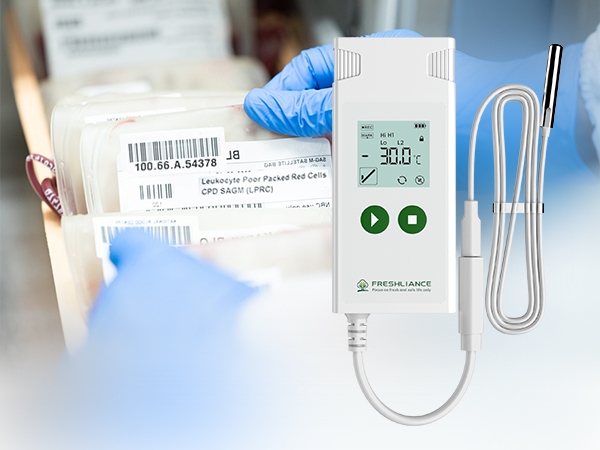
Freshliance Atlas Log-30 Temperature Data Logger is a USB temperature data logger with an external probe for transportation and storage monitoring. It covers -30°C to +70°C, with a stated accuracy of ±0.5°C F.S. and a resolution of 0.1°C. Its IP65 rating, LCD display, configurable logging interval, and USB report workflow fit many refrigerated blood cold chain shipments, pharmacy refrigerators, walk-in coolers, biological samples, and diagnostic reagent applications.
Atlas Log-30 Temperature Data Logger can store up to 35,000 readings for PDF reporting, or up to 20,000 readings in each format when PDF and CSV are selected. Its logging interval and start delay can each be configured from 1 minute or 0 minutes up to 24 hours.
Atlas Pro-IUT for Dry Ice and Ultra-Low Temperature Use
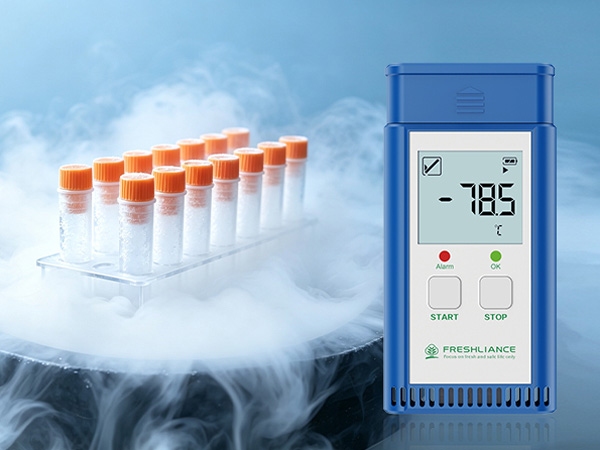
Dry ice transport requires a different temperature range from ordinary refrigerated distribution. Freshliance Atlas Pro-IUT Dry Ice Temperature Data Logger is intended for ultra-low temperature documentation, with a listed range of -90°C to +70°C,±0.5°C F.S. accuracy, and a recording duration of up to 120 days. Atlas Pro-IUT Dry Ice Temperature Data Logger is intended for applications that specifically require ultra-low-temperature or dry-ice monitoring. It may be relevant to selected biological materials, pharmaceuticals, or selected blood or plasma applications where the validated transport or storage procedure requires an ultra-low-temperature environment.
The model supports USB retrieval, PDF and CSV reporting, up to 6 alarm points, and up to 9 marks. Use Atlas Pro-IUT when the actual shipment involves ultra-low-temperature conditions and the device specifications meet the required temperature range, monitoring duration, and accuracy.
LoRa Tag LT100 for Medical Refrigerators and Facilities
Transport records show what happened during a route, but healthcare facilities, pharmacies, laboratories, and other controlled storage environments need continuous monitoring after delivery. LoRa Tag LT100 LoRa Temperature Humidity Logger is designed as a wireless temperature and humidity endpoint that sends readings through GAEA series gateways to cloud platform and mobile applications. It can support medical refrigerators, pharmacies, laboratories, cleanrooms, and other multi-point environments.
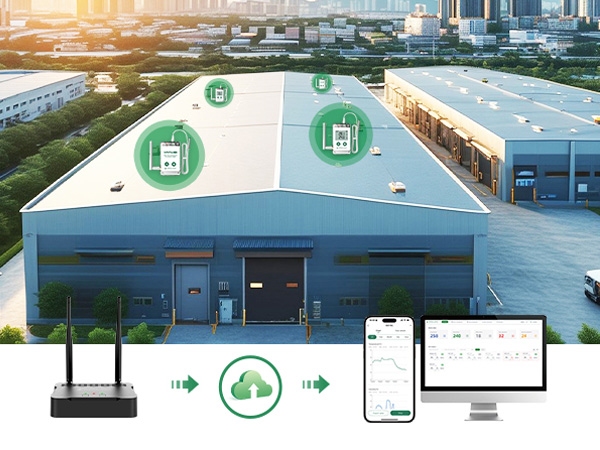
The built-in sensor covers -30℃ ~ +70℃, and 0-100% RH. Depending on the selected probe, external measurement can extend from -90℃ to +200℃. LT100 also provides up to 400 m open-air communication, 100,000 local readings, 6 alarm points, and up to 1 year of operation at a 5-minute upload interval.
Logger | Main application | Temperature range | Monitoring format | Connectivity |
Atlas Log-30 | Refrigerated transport/storage | -30°C to +70°C | External probe + USB | USB |
Atlas Pro-IUT | Ultra-low/dry ice applications | -90°C to +70°C | Temperature logger + USB | USB |
LoRa Tag LT100 | Fixed facility monitoring | -30°C to +70°C built-in* | Wireless sensor + gateway | LoRa |
Conclusion
Continuous monitoring turns the medical blood cold chain from a series of isolated checkpoints into a traceable temperature history. A temperature probe data logger is particularly useful when the monitoring location needs to be positioned separately from the logger display or main device body, when handover review must be quick, or when the shipment environment needs a record that can be examined after delivery.
With Atlas Log-30 Temperature Data Logger for refrigerated work, Atlas Pro-IUT Dry Ice Temperature Data Logger for dry ice and ultra-low temperature routes, and LoRa Tag LT100 LoRa Temperature Humidity Logger for fixed medical facilities, Freshliance supports different stages without blurring their technical boundaries. Match the device, probe, and reporting workflow to your blood cold chain application.
FAQ
Q: Why use a temperature probe data logger in the blood cold chain?
A: A temperature probe data logger can place the sensing point closer to the blood product, plasma container, or payload zone while keeping the logger body accessible. This helps create a more representative record during transport, receiving, and storage, especially when the inside of a package or refrigerator does not match the temperature near its display.
Q: When should Atlas Pro-IUT be selected instead?
A: Atlas Pro-IUT Dry Ice Temperature Data Logger should be considered when the shipment uses dry ice or another ultra-low temperature environment that requires a range down to -90℃. The route, packaging, sensor placement, recording duration, alarms, and report process should all match the current model specifications before deployment for blood, plasma, biological samples, or other medical materials.
Q: Is LoRa Tag LT100 mainly for transport or facility monitoring?
A: LoRa Tag LT100 LoRa Temperature Humidity Logger is mainly suited to fixed or distributed facility monitoring, including medical refrigerators, pharmacies, laboratories, and cleanrooms. It uses LoRa communication and a gateway-based cloud workflow for ongoing temperature and humidity visibility, alarms, and local data buffering rather than serving as a simple one-way transport recorder.
Previous: How to Choose an Extreme Temperature Data Logger for Process Validation
Next: Temperature Probes for Food Safety: Cold Chain Guide