Cold Storage Temperature Monitoring: Reduce Spoilage Risk
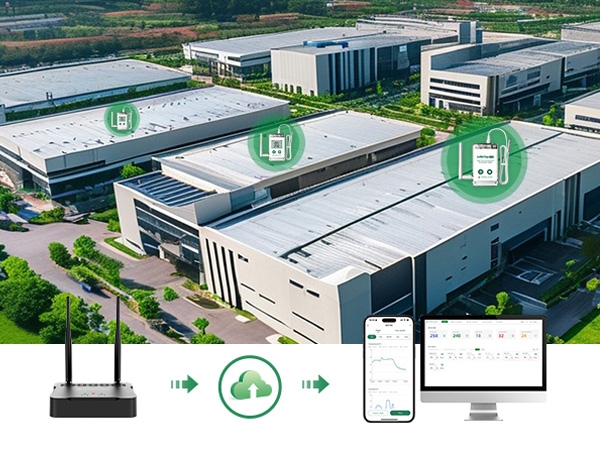
A cloud-based temperature monitoring system helps reduce product spoilage by continuously monitoring temperature and other environmental conditions, moving readings to a shared platform, and sending temperature excursion alerts when configured limits are exceeded, helping personnel respond before a temperature excursion becomes prolonged. This provides operators with more continuous visibility into storage conditions than periodic manual temperature checks.
Freshliance combines wireless temperature and humidity data loggers, gateway-based communication, cloud monitoring, mobile applications, local data storage, and optional API integration within a connected monitoring architecture.
Why Continuous Temperature Monitoring Matters in Cold Storage
Limitations of Periodic Manual Temperature Checks
A manual temperature check provides a measurement at a specific point in time, but it does not provide continuous visibility between inspection intervals. It may show that a cold room is within its expected range at 9 a.m., but it cannot explain what happened after prolonged door opening, evaporator fan failure, obstructed airflow, product loading changes, or refrigeration-system faults.
A continuous record gives operators a time-based view of the environment and makes it easier to distinguish a short handling event from a sustained temperature excursion that needs investigation.
Temperature Variations Across Storage Zones
Temperature distribution within a cold room, refrigerated warehouse, or controlled storage area can vary significantly by location. Airflow patterns, evaporator location, door openings, insulation, ceiling height, rack configuration, and product loading can create localized temperature variations.
For regulated cold-storage environments, sensor placement should be informed by temperature mapping and risk assessment rather than by selecting a convenient wall location. Mapping helps identify temperature distribution, hot spots, cold spots, and areas affected by airflow, door opening, refrigeration equipment, and product loading. A distributed temperature and humidity data logger setup can reveal differences between zones, helping teams identify locations where stored products may have greater exposure to temperature variability.
How a Cloud-Based Temperature Monitoring System Works
Sensors capture conditions at the monitored point
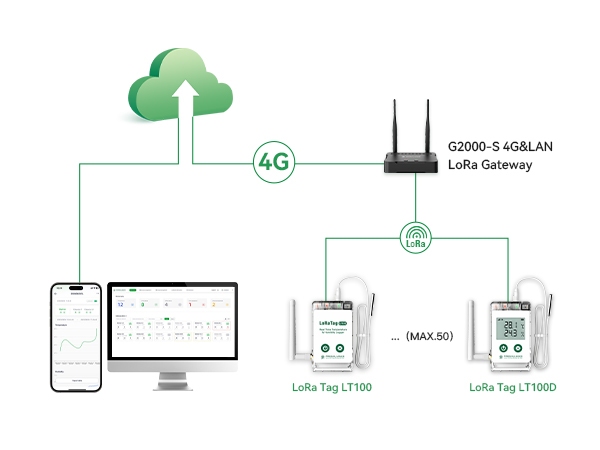
Freshliance offers WiFi/4G options for different installation patterns, so the sensing method can be matched to a fixed facility, a group of rooms, or a larger distributed site.
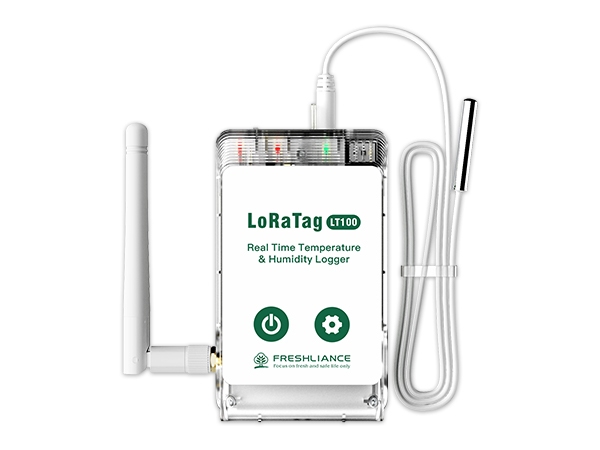
LoRa Tag LT100 Temperature Humidity Logger is designed as a wireless temperature and humidity endpoint.
Parameter | Specification |
Temperature range | −30°C to +70°C |
Humidity range | 0–100% RH |
Temperature accuracy | ±0.5°C F.S. |
Humidity accuracy | ±3% RH at 25°C, 20–80% RH |
Other RH conditions | ±5% RH |
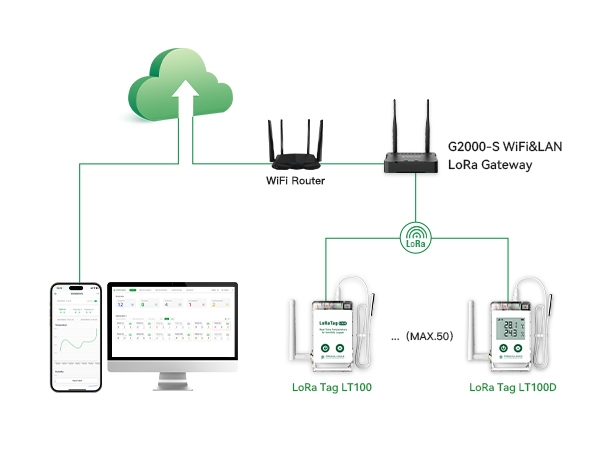
Gateways move readings into the cloud
A gateway serves as the communication bridge between wireless monitoring devices and the cloud, receiving and forwarding data from connected endpoints. Depending on the device and network architecture, Freshliance GAEA gateways collect data from compatible Bluetooth or LoRa monitoring devices and forward the data to the Freshliance cloud.
The gateway layer also supports operational continuity. In supported GAEA configurations, sensors cache data during network outages and transmit it through the gateway once connectivity is restored
Cloud Dashboards and Mobile Apps for Remote Monitoring
Effective temperature monitoring requires timely access to measurements, alarms, historical trends, and reports by designated personnel. FreshLink supports Android and iOS devices and provides access to device status, real-time and historical data, device groups, alarms, filtering, analysis, and report export. The PC cloud supports the same wider principle for teams that need a desktop view of multiple locations.
How Cloud Monitoring Reduces Spoilage Risk
Early Temperature Excursion Alerts Support Faster Response
The most immediate benefit is awareness. When an alarm threshold is crossed, notifications can be sent through app push, SMS, or email according to the configured workflow.
An alert is not a final quality decision. It is a signal that prompts the responsible team to follow its own handling and evaluation procedure. Earlier notification gives operators more time to inspect the storage area, check refrigeration equipment, verify door status, and follow the site’s excursion-response procedure.
Offline caching protects continuity
Reliable monitoring architecture should also account for temporary network interruptions through local data storage or buffering. LT100 LoRa Temperature Humidity Logger supports up to 100,000 local readings in a circular buffer, while the GAEA workflow can re-upload cached gateway data after connectivity returns.
For devices such as the LT100 LoRa Temperature Humidity Logger that provide local memory buffering, measurements can continue to be stored locally during network interruptions and synchronized after connectivity is restored. The recovered data can then be reviewed alongside the rest of the timeline, which is important when teams are investigating a suspected excursion rather than only watching the live screen.
Historical trends support root-cause analysis
A single alarm tells a team that a threshold event occurred. A graph and historical record can help show whether the change was gradual, repeated, isolated to one zone, or linked to a particular operating period.
Freshliance cloud platform and app workflows support data filtering, graphing, extreme-value reports, scheduled reports, and export. Those functions help quality, logistics, maintenance, and facility teams review the same event from different operational perspectives without rebuilding the record by hand.
How to Choose a Cold Storage Temperature Monitoring System
Fixed rooms benefit from WiFi or 4G connectivity
A refrigerator, cold room, laboratory, or other fixed space may benefit from a WiFi/4G real-time device such as Coeus. This type of setup is appropriate when the monitoring point has access to a suitable network path and the priority is direct cloud visibility, remote review, and alarm notification for a defined room or facility.
The installation should still consider sensor position, power, signal quality, and designated responsible personnel. A connected device is most useful when the person receiving the alarm can identify the room, assess the condition, and act within the site's operating process.
Large sites benefit from distributed LoRa points
Large warehouses may require a scalable wireless monitoring architecture that supports multiple monitoring points across racks, aisles, cold rooms, and separated storage zones. Freshliance LoRa Tag LT100 Temperature Humidity Logger uses LoRa communication and can send data through GAEA series LoRa gateways for centralized review.
The communication distance is up to 400 m in open-air environments, while the actual range may vary depending on installation conditions. LT100 supports up to six alarm points, up to 100,000 readings, a 4000mAh rechargeable lithium battery, and up to one year of operation at a 5-minute upload interval.
Centralized Monitoring Supports Multi-Team Operations
A centralized cloud allows operations, quality, maintenance, and management teams to access a common set of environmental records. Freshliance supports this layered workflow through app and cloud platform access, gateway-based data collection, report functions, and optional API service.
Conclusion
A cloud-based temperature monitoring system helps reduce spoilage risk by connecting continuous sensing with cloud visibility, temperature excursion alerts, local data continuity, and historical analysis. Instead of waiting for the next manual check, teams can detect temperature deviations and excursions sooner and organize a response based on the affected monitoring point, excursion characteristics, and applicable product-handling procedures.
Freshliance supports different operating patterns through WiFi/4G devices, LoRa Tag LT100, GAEA gateways, FreshLink, and cloud software. Explore Freshliance cloud monitoring solutions and match the logger, network, alert workflow, and reporting method to the conditions your facility needs to control. Contact us today to learn more.
FAQ
Q: How does a cloud-based temperature monitoring system help reduce spoilage risk?
A: It does not guarantee that spoilage will never occur. It helps reduce risk by recording conditions continuously, sending alerts when configured thresholds are crossed, storing measurements locally during supported network interruptions and synchronizing them after connectivity is restored, and giving staff historical data for faster investigation and response.
Q: Is cloud monitoring better than manual temperature checks?
A: Cloud monitoring and manual checks serve different roles. Manual checks can support routine inspection, while a connected system provides a more continuous record, remote visibility, and alerts between inspections. The best program combines suitable sensor placement, human review, and site procedures.
Q: When is LoRa Tag LT100 suitable for cold storage monitoring?
A: LT100 is suited to distributed fixed sites such as warehouses, medical refrigerators, pharmacies, laboratories, and cleanrooms. It supports LoRa communication, temperature and humidity sensing, an optional external probe, up to six alarm points, and up to 100,000 local readings for gateway-based cloud review.
Q: What happens if the network connection is interrupted?
A: In Freshliance monitoring workflows, LoRa sensors continuously record and store data during offline periods, followed by data re-upload after network recovery. This helps maintain continuity in the record, although each installation should still confirm power, coverage, gateway placement, and the response process for connectivity events.
Previous: Which Freshliance Temperature Data Logger Fits Your Cold Chain
Next: Protect Stored Products with Smart Temperature Monitoring