Facility Temp & Humidity Monitoring: IoT Data Loggers with API
Large facilities need continuous temperature and humidity monitoring across storage areas, laboratories, equipment rooms, cold spaces, and other critical zones. IoT data loggers make this possible by collecting environmental data automatically and transmitting it through LoRa gateways to cloud monitoring platforms. This architecture reduces dependence on periodic manual inspections and separate device downloads by centralizing monitoring data across multiple locations. When API access is required, temperature and humidity data can also be connected with compatible building, quality, or business management systems.
Freshliance provides the main components for facility temperature and humidity monitoring, including LoRa IoT data loggers, gateways, cloud software, alarm functions, and API integration options. Together, these components allow facilities to collect, transmit, review, and integrate monitoring data across multiple locations.
Why Large Facilities Need Continuous Temperature and Humidity Monitoring
Continuous Data Beyond Manual Checks
Many facilities still rely partly on manual checks, but periodic inspections may miss environmental changes between rounds. In a large warehouse, one storage aisle may experience elevated temperatures while adjacent areas remain within the target range. A cold room door may be left open, or an HVAC unit may experience a temporary interruption. Continuous IoT data logging helps capture these short-duration deviations and provides a more complete record of temperature and humidity conditions.
A connected monitoring system organizes these readings across rooms, racks, and other monitoring points in a centralized platform. Managers can review historical and current data without collecting files separately from every individual logger. API access can then be added when the same monitoring data needs to be transferred to other internal software systems.
Centralized Monitoring for Multiple Teams
Facility managers, quality teams, maintenance personnel, and IT staff may use the same monitoring data for different operational purposes. Maintenance teams may review abnormal conditions when investigating equipment performance, while quality teams may require historical records for audits and documentation. Management teams, meanwhile, may need centralized visibility across multiple rooms, buildings, or locations.
When monitoring data also needs to be used by internal software, Freshliance API access can extend the monitoring system beyond the cloud dashboard. The API provides endpoints for functions such as user management, device management, trip data, device groups, and configuration templates, allowing organizations to connect monitoring information with their own software workflows.
IoT Data Loggers for Facility Temperature and Humidity Monitoring
LT100 for Room and Rack Temperature & Humidity Monitoring
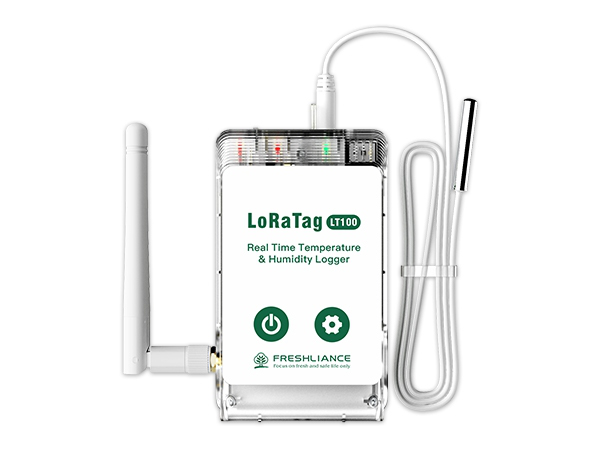
The LoRa Tag LT100 LoRa Temperature Humidity Logger is an IoT data logger designed for distributed temperature and humidity monitoring across rooms, warehouse racks, refrigerators, and other facility monitoring points. It can be used for monitoring points such as pharmaceutical refrigerators, warehouse racks, and cleanroom environments. Because its LoRa signal travels up to 400 meters in open areas, it can reach corners where Wi-Fi coverage may be limited.
The LT100 measures temperatures from -30°C to +70°C with high accuracy. It also tracks humidity and can even support an extra external probe if needed. The device can store 100,000 readings on its own and supports up to six configurable alarm thresholds.
Battery life is a big plus for this model. It has a 4000mAh battery that can last a whole year if you set it to upload every five minutes. This can reduce maintenance requirements for sensors installed in high racks or other hard-to-access locations.
LT200 for Multi-Point Facility Monitoring
The LoRa Tag LT200 Wireless Real-time Data Logger is designed for broader facility monitoring deployments where temperature, humidity, and supported external sensor inputs need to be collected across multiple monitoring points. It uses LoRa 868MHz or 915MHz frequency band to cover wide areas like logistics centers and smart buildings. In addition to temperature and humidity, it can also support gas monitoring.
The LT200 can handle two external probes at once. This is very helpful if you need to monitor two different spots inside a single large cabinet or machine zone using just one logger.
You can also choose a bigger 8000mAh battery for the LT200. This larger version can run for up to two years. If the building's internet goes down, the logger keeps recording data and sends it all to the cloud as soon as the connection is back.
How LoRa Gateways Connect Facility Monitoring Data
G2000 for Multi-Logger Facility Coverage
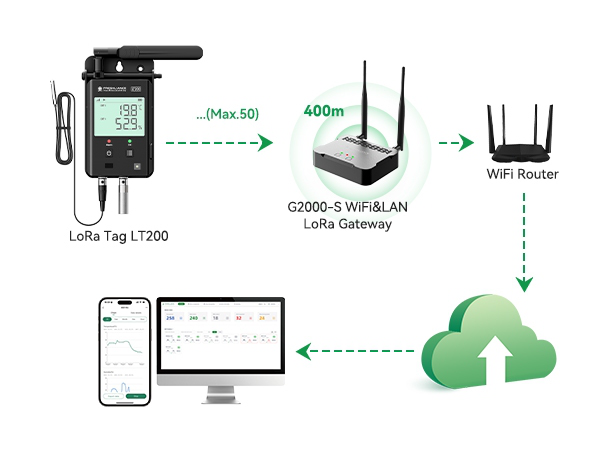
In a facility monitoring system, the gateway connects distributed IoT data loggers with the cloud. The G2000 LoRa gateway collects temperature and humidity data from compatible LoRa loggers and forwards the information to Freshliance Cloud through 4G, Wi-Fi, or LAN connectivity.
One G2000 gateway can connect with up to 50 compatible LoRa temperature and humidity loggers. This allows multiple monitoring points across warehouse aisles, storage areas, loading zones, or other facility spaces to share the same gateway infrastructure.
Cloud Monitoring, Alerts, and Historical Data
Real-time data is only useful if it helps you act. Freshliance systems can send alarm notifications through SMS, email, and mobile app push notifications when configured thresholds are exceeded. This gives teams an opportunity to investigate abnormal environmental conditions and take corrective action before temperature excursions affect sensitive products.
Looking at past data is also simple. Using the Freshliance Cloud platform and mobile app, teams can view live graphs or download historical monitoring data in PDF or CSV format. If your company uses its own internal software, the API can be used to integrate monitoring data with compatible internal software systems, reducing the need for repeated manual exports.
Facility Temperature and Humidity Monitoring Applications
Warehouses
Temperature distribution within a large warehouse may vary due to airflow, door openings, rack configuration, HVAC operation, and product loading. Open doors and different rack heights create temperature variations or localized hot spots. A LoRa temperature humidity logger network lets managers see these differences clearly by placing sensors exactly where they are needed most.
Laboratories, Hospitals, and Smart Buildings
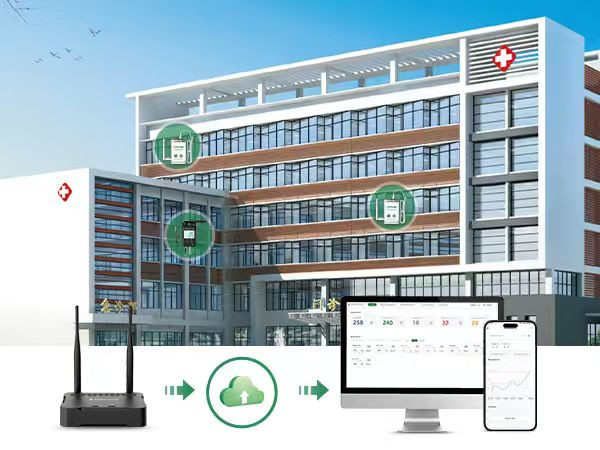
Hospitals and labs usually have many different rooms and fridges to watch. A wireless temperature data logger system saves time because automated IoT data loggers can reduce the need for repeated manual readings at every monitoring point.
By integrating temperature and humidity monitoring data with compatible building management tools through an API, teams can review longer-term environmental trends alongside other facility information.
How to Choose a Facility Temperature and Humidity Monitoring Setup
Match Data Loggers and Probes to Each Monitoring Point
System selection should begin with the monitoring requirements at each location. If you are monitoring warehouse racks, the LT100 LoRa Temperature Humidity Logger may be suitable for standard temperature and humidity monitoring points. However, if you have a complex setup with multiple points in one area, the LT200 Wireless Real-time Data Logger with its extra probes might be a better choice.
Think about the temperature range as well. While the built-in sensors work for most rooms, some projects might need external probes for extreme cold or heat. Freshliance offers different sensor and probe configurations to match the required measurement range and application conditions.
Plan Cloud and API Access Before Scaling
Before you expand the system to your whole facility, decide who needs the alerts. You should also figure out which software needs to receive the data. Planning your environmental monitoring software and API setup early on is just as important as choosing where the sensors go.
Freshliance provides an integrated monitoring setup that combines LoRa temperature and humidity data loggers, gateways, cloud monitoring, alarms, and API access. The data loggers collect information at each monitoring point, the gateway transfers it to the cloud platform, and API access can be used when monitoring data also needs to connect with existing facility or business software.
Conclusion
Facility temperature and humidity monitoring becomes easier to scale when IoT data loggers, LoRa gateways, cloud monitoring, and API access are planned as one connected system. Distributed loggers can collect data from rooms, racks, refrigerators, storage zones, and other monitoring points, while gateways and cloud software provide centralized visibility across the facility.
Freshliance offers the LT100 LoRa Temperature Humidity Logger, LT200 Wireless Real-time Data Logger, G2000 gateway, cloud monitoring, and API integration options for facility monitoring projects. Explore Freshliance solutions or contact us to discuss how temperature and humidity data can be integrated into your existing monitoring workflow.
FAQ
Q: What is facility temperature and humidity monitoring?
A: Facility temperature and humidity monitoring leverages Internet of Things (IoT) data loggers to continuously acquire ambient conditions across key monitoring nodes—including rooms, shelving units, cold-storage equipment, and storage zones. These acquired data streams are transmitted in real time via gateways to a cloud-based server, enabling centralized visualization, automated alerting, report generation, and historical data analysis through cloud platforms or dedicated mobile applications.
Q: How does API integration work with facility monitoring data?
A: API integration allows temperature and humidity monitoring data from the cloud platform to be exchanged with compatible internal software systems. Depending on the available endpoints and software configuration, organizations can use API access to connect device, user, trip, group, and other monitoring information with their existing digital workflows.
Q: Which Freshliance setup fits a large warehouse?
A: Most warehouses use a mix. The LT100 LoRa Temperature Humidity Logger is great for standard racks, while the LT200 Wireless Real-time Data Logger is better for complex spots that need extra probes. A single G2000 gateway can then connect up to 50 of these devices.
Previous: Time Temperature Indicator vs Data Logger: Which Fits
Next: High Temperature Data Logger for Harsh Industrial Processes