USB Temperature Data Logger for Pharmaceutical Cold Chains
A USB temperature data logger helps pharmaceutical teams document temperature conditions during the transportation, distribution, and storage of temperature-sensitive medicinal products. Freshliance USB data loggers provide configurable logging intervals, alarm thresholds, event marks, and USB-based data retrieval and reporting, helping reduce reliance on intermittent manual temperature readings by providing a time-stamped record at predefined logging intervals throughout the monitoring period.
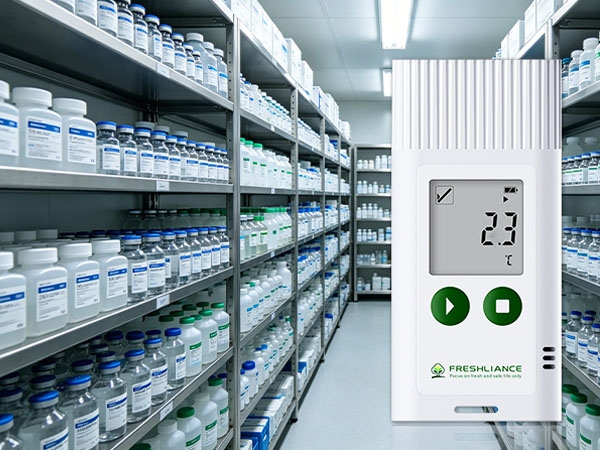
Why Temperature Monitoring Matters in Pharmaceutical Distribution
Continuous Records Support Better Decisions
Pharmaceutical temperature monitoring is not only about seeing the current temperature. Quality and logistics teams may need to reconstruct temperature conditions across dispatch, transit, intermediate handling, storage, and receipt. A data logger records temperature measurements at a predefined logging interval, allowing the receiving team to review the temperature profile rather than rely solely on intermittent manual readings.
That record supports cold chain compliance work by making temperature excursions easier to identify and discuss. It can help quality teams determine whether a shipment stayed within its required handling conditions, whether an alarm occurred during transit, and which transportation or handling stage requires further investigation.
From Shipment to Receipt
USB connectivity can simplify data retrieval when a monitored shipment reaches a warehouse, pharmacy, laboratory, or distribution facility. The logger can be connected directly to a computer, allowing recorded data to be retrieved directly through a USB interface without requiring a dedicated external reader. This can streamline the transition from shipment receipt to temperature-data retrieval and quality review.
Freshliance USB Logger Options for Pharmaceutical Cold Chain
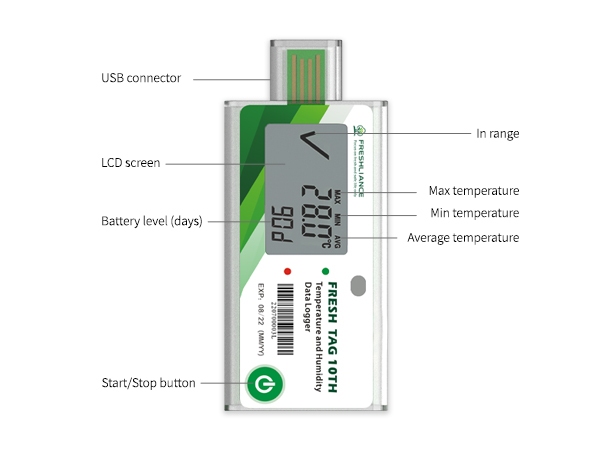
Fresh Tag 10TH for Single-Use Temperature and Humidity Monitoring
Freshliance’s Fresh Tag 10TH Temperature and Humidity Data Logger is a configurable single-use temperature and humidity data logger for sensitive products in transportation and storage. It measures from -30°C to +70°C with listed temperature accuracy of ±0.5°C F.S., while humidity is measured from 0% to 100% RH. Humidity accuracy is listed as ±3% RH at 25°C and 20% to 80% RH, and ±5% RH under other stated conditions.
The logger stores up to 65,000 readings and can operate for up to 120 days. Its logging interval can be set from 1 minute to 24 hours, with a configurable start delay from 0 minutes to 24 hours. USB is standard, NFC is optional, and the IP65 enclosure, LCD, LED alarm indication, six alarm points, and nine event marks support shipment-level monitoring, alarm identification, and event traceability.
Fresh Tag 10TH Temperature and Humidity Data Logger is intended for single-use monitoring applications where the logger remains associated with a shipment or monitoring cycle and is not routinely redeployed. The product page describes use in refrigerated containers, trucks, cooler bags, cooling cabinets, medical cabinets, freezers, and laboratories, including pharmaceutical, vaccine, and biological material cold chain monitoring.
TagPlus-TH for Reusable Monitoring Workflows
For recurring storage or internal transfer tasks, TagPlus-TH FDA Temperature Humidity Data Logger is a multi-use temperature and humidity data logger with a configurable setup and LCD display. It supports a -30°C to +70°C range, with an optional -40°C to +60°C range, 0.1°C and 0.1%RH resolution, and a maximum memory capacity of 35,000 readings. PDF and CSV output can store up to 20,000 readings each when both formats are selected.
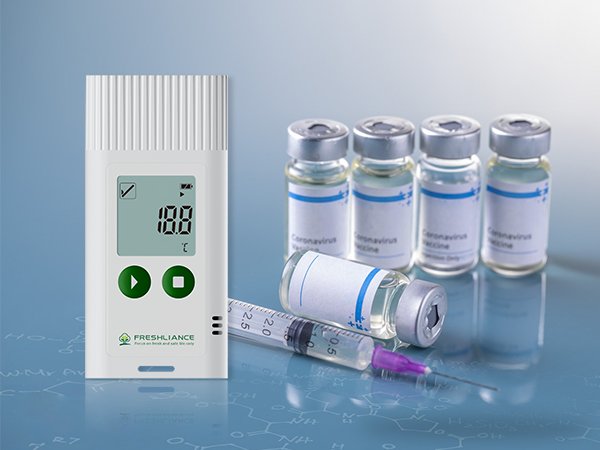
TagPlus-TH Temperature Humidity Data Logger has a stated battery life of up to three years, uses a replaceable 3.0V CR2032 lithium battery, and supports USB, optional NFC, Windows, and Mac. Its dimensions are 82mm by 39mm by 13.5mm, with a listed weight of 29.5g. The device can generate PDF, CSV, or combined PDF and CSV reports automatically on a computer, without a separate cable or reader.
Freshliance also offers Freshliance Tools-FDA, an optional software version designed to support electronic records and electronic signatures in workflows subject to U.S. FDA 21 CFR Part 11 requirements. Organizations should assess the software within their own computerized-system validation and data-integrity framework.
Report and Configuration Features That Support Traceability
PDF and CSV Reports for Handover Review
A pharmaceutical distribution workflow may require temperature records that can be reviewed after shipment, rather than relying only on a display reading during transportation. Freshliance loggers can generate encrypted PDF and CSV reports with graphs, tables, and summary information. PDF reports are suitable for human-readable review and shipment documentation, while CSV files can support downstream data analysis and processing.
The Freshliance Tools software can configure logging parameters, alarm thresholds, time zones, and report settings. It can also retrieve data, show temperature and humidity trends, calculate maximum, minimum, average, and Mean Kinetic Temperature (MKT) values, and export PDF, CSV, TXT, or PNG files.
Alarms, Marks, and Interim Checks
Configurable alarm thresholds can help identify potential temperature excursions for subsequent quality review and investigation. Event marks can provide additional context for interpreting the recorded temperature data. Together, these functions add context to the temperature logger for pharmaceuticals and make later review more efficient.
For organizations that require additional software controls, Freshliance describes Freshliance Tools-FDA as an optional upgrade designed for U.S. FDA 21 CFR Part 11 workflows. The listed functions include data encryption, access control, electronic signatures, and operation logs. The upgrade should be assessed against the organization’s own validation and quality requirements.
How to Choose the Right Logger for Drug Delivery
Match Single-Use or Multi-Use Design to the Workflow
Single-use loggers may be appropriate when the monitoring device is intended to remain with the shipment or when device recovery and redeployment are impractical. Choose a multi-use logger when the same team can retrieve the device, download the report, replace the battery when needed, and configure it again for the next storage or transfer cycle.
The decision should also reflect whether humidity matters. A temperature-and-humidity logger may be appropriate when humidity is an identified environmental risk for the product, packaging, or storage process. The appropriate USB temperature data logger should be selected based on product-specific temperature requirements, shipment duration, required accuracy, monitoring interval, data capacity, calibration requirements, reporting workflow, and device recovery strategy.
Check the Technical Fit Before Deployment
Before deployment, compare the required temperature range with the logger’s stated range, then check accuracy, logging interval, memory, battery life, protection grade, connection method, and operating system. Also confirm how reports will be named, reviewed, stored, and linked to shipment records. These controls help ensure that temperature records remain attributable, retrievable, and suitable for subsequent quality review.
Practical Application Scenarios
Pharmaceutical and Vaccine Shipments
For pharmaceutical shipping and vaccine cold chain monitoring, the logger should be positioned according to the applicable monitoring procedure, packaging qualification, and shipment-monitoring strategy. At receipt, the consignee can review the display, connect the logger to a computer, and retain the generated report with the shipment documentation. This provides a consistent handover record without requiring live connectivity during every trip.
Storage, Laboratories, and Medical Cabinets
The same approach can support freezers, medical cabinets, cold rooms, laboratories, and temporary staging areas. Fresh Tag 10TH Temperature and Humidity Data Logger is suited to a defined monitoring period, while TagPlus-TH Temperature Humidity Data Logger can be recovered for repeated checks. When the monitoring requirement changes from one shipment to a recurring site workflow, the reusable model can reduce device turnover and support a consistent reporting routine.
Conclusion
A USB temperature data logger provides a time-stamped record of temperature conditions during transportation, storage, and distribution. Freshliance supports different cold chain workflows with single-use and multi-use temperature and humidity loggers, configurable sampling, alarm and event records, USB report generation, and software-assisted analysis. Selecting the model that fits the shipment, storage stage, and quality process helps make temperature monitoring and shipment documentation more transparent and operationally manageable.
Explore Freshliance USB temperature data loggers for pharmaceutical cold-chain monitoring, shipment documentation, and temperature-excursion review.
FAQ
Q: What are the differences between Fresh Tag 10TH and TagPlus-TH data loggers?
A: Fresh Tag 10TH Temperature and Humidity Data Logger is designed for single-use temperature and humidity monitoring, with up to 65,000 readings and up to 120 days of operation. TagPlus-TH Temperature Humidity Data Logger is multi-use and better suited to recurring storage or internal transfer workflows. The choice depends on shipment duration, humidity requirements, recovery, and reporting procedures.
Q: Why are PDF and CSV reports useful for pharmaceutical cold-chain monitoring?
A: PDF reports provide a readable record with graphs and tables for handover or quality review. CSV files can support further analysis and internal data processing. Having both formats available can reduce manual transcription and make the temperature history easier to retain with shipment documentation.
Q: Is a reusable logger better than a single-use logger?
A: Neither format is universally better. A single-use logger is practical when it travels with a shipment and does not need to return. A reusable logger is useful when staff can retrieve, download, reconfigure, and redeploy the device for repeated storage or internal transport monitoring.
Previous: Real-Time Environmental Monitoring: IoT & BMS Integration
Next: No